Evaluating numerical instability in Python
Numerical diagnosis requires separating sensitivity of the mathematical problem from errors introduced by its implementation. This guide derives a cancellation example, evaluates it against a high-precision reference, and explains how repeated arithmetic experiments complement that comparison.
Conditioning, stability, and forward error
Let \(f(x)\) be an exact mathematical quantity and \(\widehat f(x)\) its computed approximation. Relative forward error is
\[E_f(x)=\frac{|\widehat f(x)-f(x)|}{|f(x)|},\qquad f(x)\ne0.\]For a differentiable scalar function with \(x\ne0\) and \(f(x)\ne0\), and a small input perturbation \(\delta x\), the relative condition number is
\[\kappa_f(x)=\left|\frac{x f'(x)}{f(x)}\right|, \qquad \frac{|\delta f|}{|f(x)|}\approx\kappa_f(x)\frac{|\delta x|}{|x|}.\]Conditioning is a property of the problem at the chosen input. Backward stability is a property of an algorithm: its output can be interpreted as the exact result for a nearby input, with a suitably small backward error. Even a backward-stable algorithm can have a large forward error when the problem is ill-conditioned. Conversely, an unstable evaluation can lose accuracy on a well-conditioned problem.
These definitions follow the classical distinction in Higham, Accuracy and Stability of Numerical Algorithms. A reference calculation tests forward accuracy at specific inputs; it does not establish a general stability theorem.
A well-conditioned function with an unstable evaluation
Consider, for \(x>0\),
\[f(x)=\sqrt{x^2+1}-x =\frac{1}{\sqrt{x^2+1}+x}.\]Differentiation gives \(f'(x)=-f(x)/\sqrt{x^2+1}\) and therefore
\[\kappa_f(x)=\frac{x}{\sqrt{x^2+1}}<1.\]The exact function is well-conditioned under relative perturbations of positive \(x\). For large \(x\), however, the direct expression subtracts nearly equal quantities. A rounding error in the square root can be comparable to the entire difference, which is asymptotically \(1/(2x)\). Rationalization avoids that subtraction.
The experiment uses math.hypot(x, 1.0) to evaluate the square root without unnecessarily overflowing x*x. This improves the intermediate calculation but cannot prevent cancellation in the subsequent subtraction.
Reproduce the experiment
Download numerical_instability.py. The calculation uses only Python’s standard library:
python3 numerical_instability.py
The script compares both expressions with an 80-digit Decimal evaluation over 25 inputs from 1 to \(10^{12}\). The Decimal reference starts from the exact binary64 input through Decimal.from_float, so the comparison concerns evaluation error at that input, rather than disagreement about how a decimal input was represented.
| Input | Direct subtraction | Rationalized expression | Relative error of direct subtraction |
|---|---|---|---|
| \(10^4\) | approximately \(5.0000000556\times10^{-5}\) | approximately \(4.9999999875\times10^{-5}\) | approximately \(1.36\times10^{-8}\) |
| \(10^8\) | 0 | approximately \(5\times10^{-9}\) | 1 |
| \(10^{12}\) | 0 | approximately \(5\times10^{-13}\) | 1 |
These values come from the recorded run. Last-bit differences in mathematical libraries can affect the table on another platform. The example checks that the rationalized expression remains below a relative error of \(10^{-14}\) over the tested range.
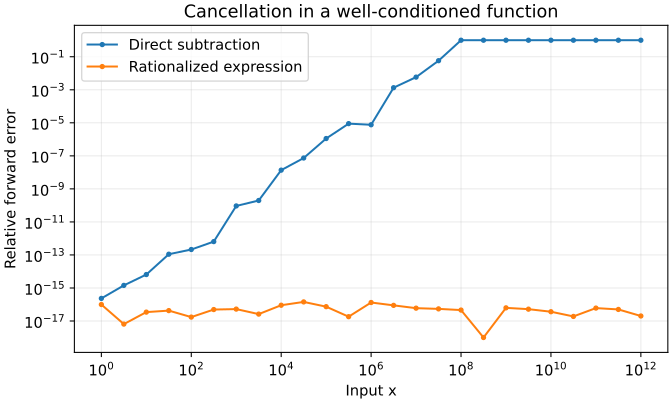
Figure: executed example results. The mathematical condition number stays below one while the direct evaluation loses accuracy. Plotted errors have a display floor of \(10^{-18}\).
To regenerate the figure, install Matplotlib 3.11.2 and run:
python3 numerical_instability.py --plot numerical-instability.svg
The recorded environment was Python 3.12.3 on Linux x86_64; plotting used Matplotlib 3.11.2 and NumPy 2.5.3. Both numerical formulas and the reference calculation are independent of NumPy.
What repeated experiments add
For arithmetic realizations \(Y_1,\ldots,Y_R\) with fixed scientific inputs, estimate the sample mean and variance:
\[\bar Y=R^{-1}\sum_rY_r,\qquad s^2=(R-1)^{-1}\sum_r(Y_r-\bar Y)^2.\]The variance characterizes sensitivity to the chosen perturbation model. It cannot detect an identical systematic bias in every realization: repeated zero outputs in the cancellation example could have zero sample variance and a relative forward error of one. Compare a distribution with a reference or an application-level criterion whenever one is available.
PyTracer helps localize variability across Python call boundaries; Verificarlo and other perturbation engines change selected arithmetic operations. Verify coverage, vary arithmetic seeds independently, and report the instrumented scope. A stable mean of an array does not establish that every element is stable.
Interpretation and references
Avoid treating a rounding experiment as measurement uncertainty or as a complete hardware model. Validate behavior near zero, underflow, overflow, and branch boundaries separately. The positive-input derivation above is specific to this function and does not extend automatically to another algorithm.
- Higham (2002), Accuracy and Stability of Numerical Algorithms, second edition.
- Chatelain, Yong, Kiar, and Glatard, PyTracer: Automatically profiling numerical instabilities in Python.
- Sohier and colleagues, Confidence intervals for stochastic arithmetic.
- Monte Carlo arithmetic and stochastic rounding.